Sunday, January 20, 2019

What do you do with doorstep evangelists?


As others have said, you can’t be too zealous for Christ. And I would add, it isn’t evangelists' zeal that turns people away, it is the lack of love. Love, expressed with zeal, attracts and transforms. But the mere desire to change others, expressed with zeal, repels and offends.

Image result for Mormon evangelists image
When evangelists show up on my doorstep on Saturday morning, they know nothing at all about me: my joys, my struggles, my relationships. They just want to convert me into them. This is, at best, annoying.

On the other hand, when a friend perceives that I’m struggling with problems, invites me to lunch and offers to pray with me, they truly want to help me and I know they love me. This can be transformative.

If you have Christian friends who are being zealous in the first sense, I suggest you lovingly pull them aside and express your concerns that their efforts are not only ineffective, but counter-effective. The key is to deal with them in love; if love doesn’t change them, stop trying and merely pray for them.

Monday, September 24, 2018

Christ and the Military

Jesus taught love and peace. Soldiers kill.
How on Earth can you be a Christian and a soldier at the same time? Believe me, I spent all of my 36 years in the military wrestling with this. And that much reflection has produced volumes of notes. Here is a short synopsis:
The warrior God
You don’t have to read very much of the Book of Joshua to realize that our God has no real problems with armies, conquest, imperialism and even genocide. This does not seem to be the gospel preached by Jesus, but in fact it is one and the same God! If God detests war and soldiers, why did he command so much war and bless soldiers such as Joshua and David? If we perceive a conflict, we must misunderstand who God is.
Thou shalt not kill
Kill is a very inaccurate translation, unfortunately used in the King James Version. Almost all modern translations use the more accurate word murder. As C.S. Lewis said, “All killing is not murder any more than all sexual intercourse is adultery.” The difference, of course, is hatred. Soldiers should kill because it is their duty and because they believe in a cause — not because they hate the enemies personally. Matthew 5:21-26 makes it clear that the sin in murder is hatred, not killing.
Pacifism
On the surface, many of Jesus’ sayings appear to be pacifist, but only if you make words uttered in a specific context universally applicable.
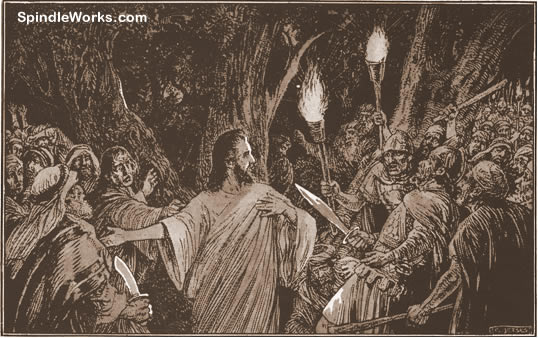
Matthew 26:52 records Jesus as saying, “Put your sword back in its place, for all who draw the sword will die by the sword.” Is Jesus saying i) anyone who tries to prevent his arrest will be killed; ii) anyone who participates in an uprising against Rome will be killed; or iii) anyone who is a soldier is damned? The last possibility makes no sense.
Matthew 5:39-44 has Jesus saying, “If anyone slaps you on the right cheek, turn to them the other cheek also… love your enemies and pray for those who persecute you.” But the context is the Beatitudes, directions for individual loving behavior, and these words prohibit hatred. It is an unreasonable stretch to apply this to society rather than individuals.
Defiance
Jesus did not spend his ministry submitting to power; he spent his ministry defying power. He had little but contempt for King Herod [Luke 23:8-12], church leaders [Matthew 3:7], and the Roman governor Pilate [Matthew 27:11-14]. And his disdain was not limited to non-violent resistance: in John 2:15 he made a whip out of cords, drove all from the temple courts, and overturned their tables. Not passive!

Roman soldiers
Jesus lived in a country under military occupation, and he often encountered Roman soldiers. And on every occasion he had nothing but kind words for them. In Luke 3:14 John did not tell the soldiers he was baptizing to quit, he only told them to be honest; in Luke 7:1-9 Jesus praised the centurion for his great faith; and in Luke 23:34 Jesus forgave the soldiers who were crucifying him! This does not sound like a man opposed to the profession of arms.

Just War
St Augustine started a fifteen-century-long debate among Christians about just war. I sincerely believe that there are just wars. But I won’t repeat his arguments here; I suggest you have a look at wikipedia.org/wiki/Just_war_theory 


I could go on at length on any of these and a number of other lines of reasoning. But I hope that this has served as a nice introduction to the topic for you.
And even more importantly, I hope you think long and hard about not whether Jesus wants you to bear arms, but how Jesus wants you to bear arms!

Tuesday, February 7, 2017

Faith and Doubt

I am a Christian, but I am open to the possibility that God does not exist. This is not at all a paradox: I find that doubt and belief go hand-in-hand:

  • Intellectually, I have not seen a good proof of God's existence. Ergo doubt. But at the same time, I find the Christian story to be both credible and compelling. It answers deep philosophical questions within me.
  • Emotionally, I find the prospect of a morally relative world filled with selfish beasts to be horrifying. I am appalled by injustice. I am troubled by my own inadequacy and mortality. I find the Christian story of justice, mercy and love more than just comforting, I find it joyful.
  • Volitionally, I have decided to walk with Jesus. I have decided to try to do his will, even when I doubt, or am sad, or am angry. I pray to him, I read his words, I commune with his people. And in return for my decision, he has blessed me with assurance and joy.

So I am not 100% sure that God exists, but I have found that he rewards my obedience and search for him. I have found this verse to be true:
You will seek me and find me when you seek me with all your heart.
- Jeremiah 29:13

Sunday, August 7, 2016

Intellectual Arrogance and Faith in Science

All the Athenians and the foreigners who lived there spent their time doing nothing but talking about and listening to the latest ideas. Paul then stood up in the meeting of the Areopagus and said: “People of Athens! I see that in every way you are very religious. For as I walked around and looked carefully at your objects of worship, I even found an altar with this inscription: to an unknown god. So you are ignorant of the very thing you worship—and this is what I am going to proclaim to you.” – Acts 17:21-23

As a trained Pharisee, I’m sure Paul was impressed by the intellectual zeal of the Athenian philosophers. They loved knowledge and understanding, and wanted to approach everything in life with a rational view. Doesn’t this sound familiar! We live in a world where people love the titillation of new scientific discovery, stuff their heads with scientific factoids of no possible value to their lives (like the Large Hadron Collider, pictured at right), and place their hope for the resolution of suffering in technological breakthroughs, surely just around the corner, that will herald a new age of peace, prosperity and happiness.

Of course, this is all fantasy. Or perhaps even a malicious lie.

Just look at the past hundred years. The science of eugenics said that we could perfect the human race only if we selectively remove inferior individuals, which led to the horrors of the holocaust. Chemistry told us that a new wonder called DDT would wipe out mosquitoes and eliminate malaria, which did untold damage to ecosystems. Science has harnessed the stored energy of fossil fuels, which in releasing humans from physical labour have started a global climatic crisis we may not be able to contain.

The problem is, of course, arrogance. We think we understand things, and we do understand them just enough to manipulate them for short term gain. But of course our comprehension is shallow: we don’t fully understand things, and we have absolutely no inkling of the unintended consequences. Our world is far more complicated than we would like it to be, and certainly more complicated than our simplistic models of it.


So it this knowledge, this science really worthy of our love and hope? Where should we put our trust?

Wednesday, March 2, 2016

What is God like?


The only thing I’m sure about God is that nobody has a correct idea of what God is really like. How could we possibly imagine, much less understand, what an infinite, omnipotent, omniscient, omnipresent being could be like?

We struggle to understand why God allows children to starve, why God allowed Hitler and Stalin to do what they did, why he allows earthquakes and plagues. We struggle with his foreknowledge, which seems to preclude our free will. We often act as if God doesn’t love us or he isn’t watching us. And we have a hard time accepting that he could possibly forgive us despite our selfishness and hypocrisy.

So we have some preconceived notions about what God ought to be like, but sometimes these don’t match how God acts in the Bible, in history and in our lives. There are two possibilities here: either God doesn’t exist, or else he is not at all like what we imagined. As Chrys Jordan said:
I don't actively disbelieve in the "Christian God," so much as I seriously doubt such an entity exists. In my mind, such an entity is far too petty and too small to be the Creator of Everything. When I hear that God made everything in six days, I cannot but think: look at the world. Look at the universe. You think God is so small. When I hear that God is obsessed with trivial matters such as homosexuality, I cannot but think: look at how great the universe is. Do you think the source of all things is obsessed over trivia? The only thing I will say is that God must be great, and the image many Christians have of him must fall short.[1]
We find out some things about God from the Bible, but this is difficult, since much of the Bible is allegorical. For example, God told Abraham to kill his son Isaac and then intervened; does this episode show a hard, demanding God or a forgiving, loving God? Is the lesson to obey God no matter what, or to put an end to the Bronze Age practice of human sacrifice?

We inherit some ideas about God from our culture and religious tradition, but this is shifting sand, since our image of God has changed considerably in the past couple centuries. Consider, for example, the wrathful, righteous, judging God of the Puritans. Our modern idea of God is little like that of John Knox!

We get some of our ideas about God from personal experience. When I cry out to God in anguish and grief, he comforts me in very special ways. When I look at a tree swaying in the breeze, feel the warm sun on my face, listen to a gurgling brook, smell the rich earth on a farm and taste a freshly picked wild raspberry, I am in what the ancient Celts called a thin place and I feel particularly intimate with God.

But my encounters with God are not at all like yours. Some of our very real perceptions contradict each other. Even within my own life, surely some of my profound life-shaping events were pure coincidence or brain chemistry, and not divine intervention.

We have no shortage of ideas about what God might be; I would suggest that we have too much material to work with and we need to do some judicious editing. As J
eff Wilhite said,
I spend a lot of time continually challenging everything I believe. This makes my faith, my love for God and my understanding of Him so much stronger. Some of my most deeply held theological beliefs have been molded and shaped by the need to respond to very valid criticisms.
Some people’s faith is too rigid to bend. If you grow up believing that the Bible is the inerrant word of God and then you are confronted with the possibility that it might not be so inerrant after all, you have a decision to make. Do you throw out inerrancy or do you throw out God?

Many people will tell you that after enough of this theological whittling you will be left with no faith at all so you are better off scrapping it all to begin with, but I vehemently disagree with that sentiment.
In this process of theological whittling, you are only shaving away falsehoods. God is truth, and, as such, He has nothing to fear by your sincere and honest searching for truth. A fundamentalist faith (or even the picture of God many atheists hold) is just a solid, featureless block of wood. But after enough of this sincere searching for truth and whittling away at falsehoods, the face of a good and beautiful God begins to emerge. [2]
We discover God, piece by piece. We will not likely be fortunate enough to have him reveal himself as he did to the prophets of old, but that does not mean that he cannot be found.

Where do we start? When asked many years back what portions of the Bible should be retained as a foundation for one’s evolving faith, I had no good reply at the time; since then I have realized that this is precisely what the creeds were invented for. Take, for example, the Nicene Creed:
We believe in one God, the Father, the Almighty, maker of heaven and Earth, of all that is, seen and unseen.
We believe in one Lord, Jesus Christ, the only Son of God, eternally begotten of the Father, God from God, Light from Light, true God from true God, begotten, not made, of one Being with the Father. Through him all things were made. For us and for our salvation he came down from heaven: by the power of the Holy Spirit he became incarnate from the Virgin Mary, and was made man. For our sake he was crucified under Pontius Pilate; he suffered death and was buried. On the third day he rose again in accordance with the Scriptures; he ascended into heaven and is seated at the right hand of the Father. He will come again in glory to judge the living and the dead, and his kingdom will have no end.
We believe in the Holy Spirit, the Lord, the giver of life, who proceeds from the Father and the Son. With the Father and the Son he is worshiped and glorified. He has spoken through the Prophets. We believe in one holy catholic and apostolic Church. We acknowledge one baptism for the forgiveness of sins. We look for the resurrection of the dead, and the life of the world to come. [3]

Nearly all of this is paraphrased from Biblical texts, and that which isn't comes from widely-accepted exegesis of Biblical texts. So this creed is on solid scriptural ground; it is concise enough that it is practical for every day; and it has stood the test of many centuries of examination. While it spends many words to refute heretical ideas, it consists of positive assertions we can use to formulate our own concept of God.


Wednesday, September 2, 2015

Why Christianity?

I am enough of a skeptic that I won't ever talk about the "one true religion." It may be impossible to justify such a claim, and history is replete with examples of such claims causing great harm.

What I can do is explain why I have chosen Christianity as my faith:
1. It provides a coherent world-view. I reject any religion that conflicts with widely accepted science.
2. It acknowledges that I am flawed. I know this to be true, so I reject any religion that insists I need to perfectly obey a set of rules.
3. It provides a remedy for my flaws. I reject any religion that leaves me helpless and hopeless.
4. It has sufficient documentary and archaeological evidence to be feasibly historically correct. I reject any religion that unbiased historians reject.
5. It provides me with a community of faithful, who can support me, from whom I can learn and with whom I can celebrate. I reject any religion that ignores my social needs.
6. I have found Christianity to answer my deep spiritual needs for comfort, love, peace and joy, and over the years I have come to know my creator as a person who loves me.

Monday, August 31, 2015

What is Faith, Anyway?


Note: I've been participating in an online discussion forum called Quora for over a year now, and as well as reading some very thought-provoking questions and replies from others, I have done a lot of outside reading and thinking myself. Several threads I'm following have to do with the nature of religious faith, and here are my current observations about faith.

The word has several meanings. Part of the reason why there is some contention about what faith is, is because faith has several related meanings:


  • An inner attribute. It is the motive to confide in things that are uncertain but useful or desirable. Like all elements of character, it can be strengthened with practice, but atrophies with disuse. In this sense it is related to the words belief, trust, confidence, hope, conviction or allegiance;
  • world-view. It is the complete set of axioms that underpin our understanding of our world. We commonly say that we believe certain tenets which cannot be shown conclusively to be true.  This means that we accept them because they complete our model of how life works, and allow us to make coherent decisions in the face of unknowns and uncertainty. In this sense it is related to the terms religion, system of belief or set of principles; and
  • lifestyle. It is the aggregate of all the actions we take that result from the world-view.

Faith is a very rich concept. Faith has many attributes - it is:
  • Subjective. Much of the evidence we have for our faith is based on personal experience. Although there is also objective evidence for the tenets of our faith, most is circumstantial and in aggregate it is supportive but not conclusive. Although some people are convinced that objective evidence conclusively shows their tenets to be true, if this were true then much of the scientific community would accept those tenets;
  • Volitional. We choose to accept certain tenets into our world-view and then choose to live accordingly. Although we can (and should) continue to explore our doubts, we take confident action despite uncertainty. Although some people base their faith on an authority (such as a priest, the church or scripture), in the final analysis the power of that authority derives from the adherent’s assent;
  • Rational. Faith is logical, rational and methodical, being based on reason and both subjective and objective evidence. It is not scientific, as the most convincing evidence is subjective and the empirical evidence is non-conclusive. But we can be rational without being scientific;
  • Dynamic. Our faith changes with time, both in its tenets and its strength. Whenever we make an error, it is reasonable to examine its causes; sometimes it is a result of an inaccurate tenet of faith. At this point it would be silly to hang onto the tenet rather than to learn from experience and modify our world-view. Further, our successes and failures cause our confidence in our world-view to grow or shrink;
  • Consistent. Faith should not contradict our observations and experiences, or the trusted observations of others (for instance, science). If we hang onto a tenet of faith despite contradictions, we say that that faith is blind rather than rational; and
  • Necessary. We need to make assumptions to combine with incomplete knowledge in order to make life choices. Disallowing these assumptions may make a rational choice impossible. For instance, we can never be certain that our choices of career or spouse were the best possible. An element of faith was required: we hoped or trusted that the outcome would be satisfactory.

Food for thought!